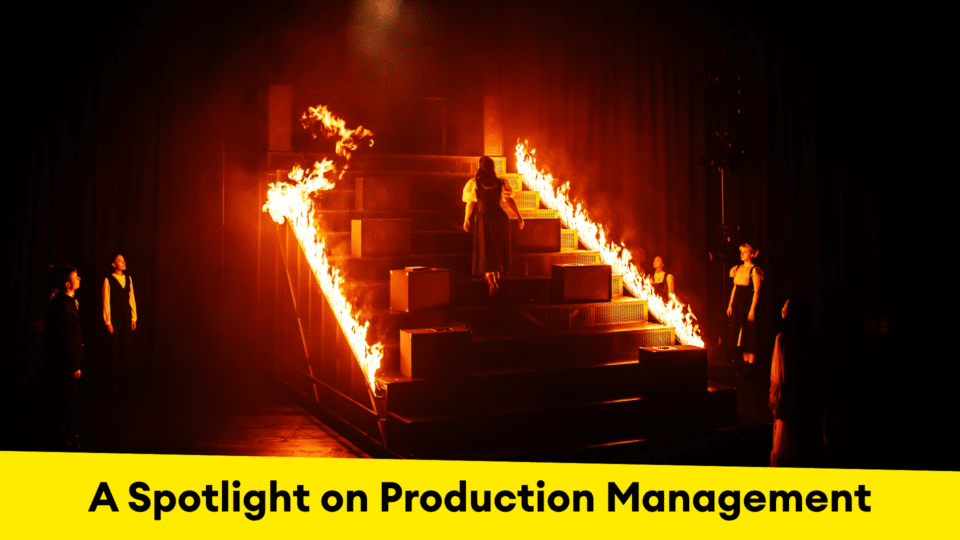
If you saw our Mercury Production of Jane Eyre this autumn then you’ll know our Technical Stage Management team pulled off a fantastic feat of engineering by bringing flames to the the Mercury stage! In this guest blog post written by Jill Robertshaw, Production Manager, she explains the process of going from idea to ignition…
In the planning stages of Jane Eyre, we had design meetings where the Designer, Anna Yates, presented their set model and explained what they would like to happen as part of the action. In this case, it was how the staging of the burning of Thornfield (Rochester’s house) would happen.
To present fire on-stage you could use a lighting effect or projection, or silks and a fan. However, it was clear that both Anna and the Director, Lily Dyble, were really keen on having real fire as part of the action. Realising the practicalities of artistic visions is where I come in as the Production Manager. The Production Manger looks after all of the backstage aspects of the performance, both from a physical and budget point of view, as well as looking after everyone’s health and safety.
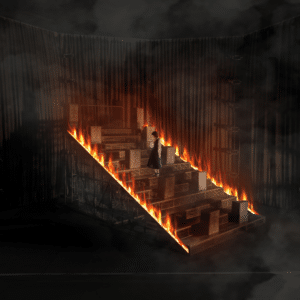
For those of you who are familiar with the story of Jane Eyre, you will know how Bertha Rochester, Mr Rochester’s ‘mad’ wife, sets fire to the family home at the end of the story. For the stage version, the script reads:
HUGE TRANSITION/THEATRICAL MOMENT: STAIRS TURN, FIRE LEAPS UP: Jane’s decision to return coincides with Bertha setting Thornfield alight.
Anna presented a picture of the large staircase, which is the set for Jane Eyre, with flames coming out of each side.
My job was to work out if we could do this, safely and within budget. There are a few other considerations – the stairs moved in a circle as part of the action, so the fire needed to be wireless and ideally controlled from off-stage. The show is also part of a small tour, so the effect needed to come apart and be re-assembled.
With all these considerations, it was clear that I needed some help with the practicalities of this.
In the first instance, I got in touch with the other venues on the tour to check their naked flame policies. If any of the venues had a blanket ban then it would have been a no to the flames. However, luckily, they were all happy with this in principle as long as the fire had the appropriate RAMS (risk assessments and method statements).
I then went on a site visit to the Rose Theatre where their Head of Production, Dan Rainsford, suggested I tried Pyro Mark for the fire effect. Dan had used Pyro Mark for other fire effects and highly recommended him.
I got in touch with Pyro Mark and sent him the picture of the staircase with the flames and asked if he could build a flame effect with all the constrictions – and Mark said yes! We also had a conversation about the cost as we had worked out how much we could allocate to this as part of the budget – luckily this all aligned.
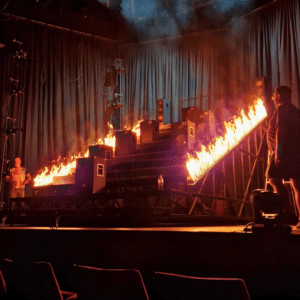
Pyro Mark came to visit us just before rehearsals started in Colchester to see the stairs and measure up. We had the stairs in the rehearsal room by then so he could see them properly and also speak with Phil Attwater, our Head of Construction, about how we would attach the pipes to the side of the stairs.
The next time I saw Pyro Mark was during the fit up when he and his assistant SB came to install the effect – in the dark, as we were also doing lighting at this time. This had been planned and is common practice!
The effect is run off two bottles of propane which are connected to the pipes on the side of the stairs. There are two hot plugs, which on cue are turned on, then we release the gas and the flames burn. The effect is run by the Company Stage Manager, Jason Benterman, who has a remote control at the side of the stage and, most importantly, a clear view of the stage so he can check that none of the actors are close to the flames.
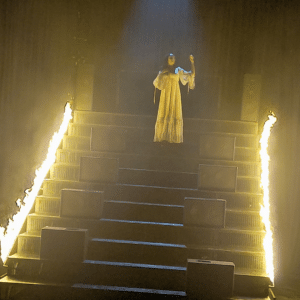
Once the actors joined us, we showed them the effect, then they stood in the positions and we ran through the action. We did this a few times to make sure they were happy and felt safe.
The fire moment was re-worked after the first preview to make it the theatrical moment that audiences saw in the final version of the show, and to be honest, I do get goose bumps when I watch the sequence.
Working on this production has been the latest in a series of challenges since I started at the Mercury just over a year ago. Since then I’ve hung people (The Manningtree Witches), set the set on fire (Jane Eyre) and brought to the stage eight productions. Currently, we’re planning shows for 2027 and working on the Mercury’s Christmas shows… tomorrow, I am going to be working with part of a beanstalk!
Newer Blog Post Older Blog Post Back to Blog